
Comparisons
Society Kart vs inDrive: Two Ways to Agree a Fare Before You Travel
inDrive made fare negotiation popular in Pakistan. Society Kart's car booking also lets you agree the price — but with local, approved car vendors and a suggested fare based on real road distance. Here is how they compare.
inDrive became popular in Pakistan with a simple idea: instead of the app fixing the price, the passenger proposes a fare and drivers can accept or counter-offer. Many people like the feeling of control that gives.
Society Kart's car booking shares part of that spirit — you agree the fare before you travel — but it is built differently. It is designed for residents of a housing society, works with approved local car vendors, and starts every trip with a suggested fare calculated from real road distance.
This guide compares the two so you can choose the right one for each trip.
We describe inDrive in general terms, based on publicly available information at the time of writing. Their features and availability may change, so check the inDrive website or app.
How fares are decided
On inDrive
With inDrive's model, you enter your route and offer a price. Drivers see the request and can accept your fare or propose their own. You choose which offer to take. It is flexible and works across many cities.
On Society Kart
Society Kart combines a reference price with offers:
1. You choose pickup, drop-off, optional stops, date and time, one-way or return. 2. The app calculates the road distance and shows a suggested fare — currently Rs. 600 for up to 5 km, then Rs. 150 for each started kilometre after that. 3. Approved car vendors in your area send offers. 4. You accept the offer that suits you, and the agreed fare is recorded in the app.
The suggested fare gives both sides a fair starting point, so nobody has to guess. Check live examples on the Car Booking page.
Who drives?
On a large open marketplace, any approved driver in the area can respond.
On Society Kart, trips go to car vendors who have been verified for your area — local people and small rental businesses who serve the society regularly. For planned trips like a wedding, a family visit or a hospital appointment, many residents prefer that familiarity.
The trade-off is size: a society-focused network is smaller, so for an instant ride at 3 a.m. across the city, a large network is more likely to find someone quickly.
Planned trips vs instant rides
Society Kart car booking shines for planned travel:
- Airport pick-ups and drops
- Family events and weddings
- Day trips with stops
- Return trips with waiting time
You choose the date and time in advance and agree the fare with the vendor. Instant, on-demand rides are where large ride apps are strongest.
Privacy
Both customers and drivers care about privacy. On Society Kart:
- Your phone number is never shown to the car vendor, and theirs is not shown to you.
- You chat and call inside the app, linked to the booking.
- Numbers typed into chats are blocked automatically.
This is the same rule Society Kart uses for shops and delivery riders. Read more in Your Number Stays Private.
Payments
Car bookings are settled between you and the vendor as agreed in the app — usually cash, or a wallet transfer. Society Kart records the agreed fare so there is no confusion later. A flat platform fee is charged to the vendor per completed booking (currently Rs. 200), not added on top of your agreed fare.
One app for more than rides
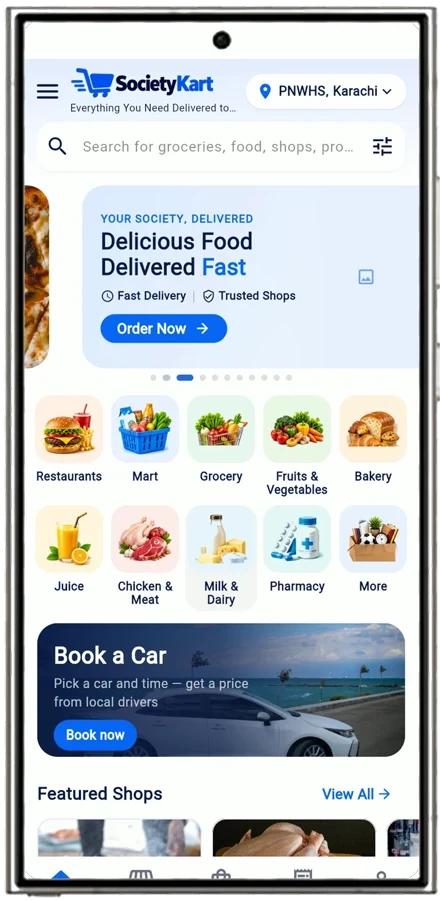
The biggest practical difference: Society Kart is not only for cars. The same app lets you order groceries, food, medicine, milk and more from the shops in your society, with delivery by local riders. If you already use Society Kart for daily needs, booking a car in the same app — with the same privacy rules and support — is simply convenient.
For car owners
If you own a car or run a small rental business:
- You receive trip requests from residents in your area.
- You send your own offer, using the suggested fare as a guide.
- You see bookings and earnings in the app.
- A flat fee applies only to completed bookings.
Apply through Partners or contact us. Every vendor is verified before going live.
Quick comparison
- Fare model: inDrive — passenger proposes, drivers counter. Society Kart — suggested fare by road distance, vendors send offers, you agree.
- Network: inDrive — large, many cities. Society Kart — approved local vendors in your society's area.
- Best for: inDrive — on-demand rides. Society Kart — planned trips, returns, stops, family travel.
- Extras: Society Kart — same app for groceries, food and pharmacy delivery.
- Privacy: Society Kart — numbers never shared; in-app chat and calls.
Frequently asked questions
Is the suggested fare the final price?
No. It is a fair starting point based on distance. The final fare is the offer you accept.
Can I add stops or waiting time?
Yes. You can add stops and choose return trips; vendors take these into account in their offers.
Where is car booking available?
Starting with the area around PNWHS, Bin Qasim, Karachi. It expands with each new society.
How do I contact the driver?
Through in-app chat and calls. Phone numbers stay private.
Order from shops in your society with Society Kart.
Explore Society KartRelated

Society Kart vs foodpanda: Which Delivery App Fits Life in a Karachi Housing Society?
foodpanda is Pakistan's best-known food delivery brand. Society Kart is built for one thing: the shops inside your own housing society. Here is an honest, side-by-side look at how they differ and when each one makes sense.
Read article
Society Kart vs Careem: Super App Convenience or Society-First Service?
Careem made ride-hailing everyday life in Pakistan. Society Kart focuses on the shops, riders and car vendors inside your own housing society. We compare what each does best — rides, deliveries, payments and privacy.
Read article
Society Kart vs Bykea: Local Delivery for Everyday Needs in Karachi
Bykea is a familiar name for bike rides and parcel delivery in Pakistani cities. Society Kart focuses on ordering from the shops inside your own housing society, delivered by riders from the same society. Here is how they differ.
Read article